Above Ground Tunnels?

Image

The State Government is considering allowing more buildings above railway lines. Planning Minister Hazzard said this would invigorate the Sydney landscape. He called on developers to ‘knock on Sydney’s door”.

The idea would be to construct high-rise residential towers built over railway lines. In one report, St Leonards and Chatswood were mentioned. A key advocate of the current suggestion is Chris Johnson, former State Architect. Johnson was also behind the design of the towers being constructed around Chatswood Station. Johnson is now the CEO of the Urban Taskforce, a key developer lobby group with considerable sway within the government.

Such proposals are likely to result in seventy story towers near heritage buildings

Fullers Bridge Safe?

Image

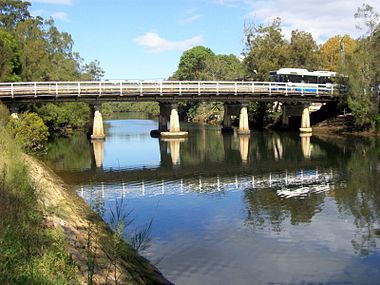
Willoughby State member the Hon. Gladys Berejiklian MP was asked recently to investigate the operational life of the Fullers Bridge over the Lane Cove River. She was asked if there are regular inspections undertaken of the bridge. It was pointed out to Gladys that like other bridges across Sydney the bridge may have reached the end of its design life. This request was prompted in response to the Draft Metropolitan Strategy which takes a 2031 horizon for infrastructure projects. The Sydney Harbour Tunnel, completed in 1989, for instance was given a 30 year life span.

Fullers Bridge was built in 1918 (95 years ago). It replaced an earlier wooden bridge at the same location.

School Upgrades

Chatswood Primary

The 2013 State Budget makes provision for new schools and upgrades within the Willoughby City area and nearby communities.

In West Ward, our two Public Primary Schools will all receive new classrooms.

Mowbray Public School on the border between Willoughby and Lane Cove Councils will be re-built to accommodate around 800 students (current enrolments are around 200 students. The proposal is to basically rebuild the school so that it meets the needs of students coming from the large number of high-rise developments proceeding in the Lane Cove Council area. The planning for the rebuilding project will take around one year. New buildings will most likely be 3 storeys (to minimise the building footprint and provide for the maximum amount of open space). A key aspect of planning for the site acknowledged by the Department of Education and Communities (DEC) is to preserve the open space on the site (including the oval and significant vegetation). The DEC are in the process of commissioning a traffic study that will assist in locating addition drop-off/pick-up zones, crossings and other associated safety matters.

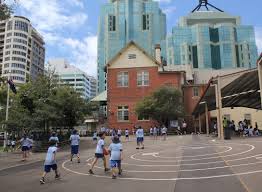
Chatswood Public School has been bursting at the seams for a number of years. It is required to take in an ever increasing number of students emanating from the high-rise buildings within the Chatswood CBD. The site is severely constrained. There is little open space and the main building is heritage listed. The first stage in attempting to resolve the space issue is that a number of additional demountables will be installed on the Chatswood High site.  It is proposed that these demountables will be used by year 5 & 6 primary students.

Female citizen

In May 1865, sixty-seven citizen residents in the Rural District of Willoughby petitioned the Governor praying for the incorporation of the Municipality of Willoughby. One of the petitioners was one Joane Howard.

What do we know about Joane ?

North Shore Lands

The area now known as the City of Willoughby was c.1788 as the North Shore. The earliest land grants on the North Shore were made in 1794. On the 30th October grants of 30 ac (12 hectares) were made to three settlers (Henry Hacking; Robert Watson; Obadiah Ikin and Thomas Whittle in what is now the Municipality of Lane Cove. At the time the area was .Shortly after, on the 19th November, 1794 land grants of 25 ac (10 hectare) each were made to 14 settlers in what was described as being the North Side of the Harbour of Port Jackson. These grants were all within current day Willoughby.. Three of the grants, appear to lie within the current suburb of Chatswood. The others are within current day Artarmon. Three of these grants appear to be within the suburb of Chatswood. A circa. 1880 map shows the location of John Fleming’s allotment next to two other blocks owned by William Hall and Benjamin Johns (it is assumed that the original grantees would have sold their allotments to those two).

It appears that in 1795 the area to rge south of Mowbray Rd (extending toward present day Artarmon) was known as the District of Hunter’s Hill.

The outline of these early land grants are shown on the map (p.14 Russell, 1965).

There is reference to a 1799 map with a note besides references to grants saying “The whole district deserted“.

The area east of the Land Cove River was also part of the District of Hunters Hill. Later the western part of the District of Hunters Hill was known as Lane Cove.

On 18th December, 1805 a grant of 200 ac (80 hectare) in the District of Hunter’s Hill was given to Isaac Nichols. Nichols called this grant “King’s Plains”. This grant straddles the present-day railway station and part of the Chatswood shopping centre. In 1806, Nichols offered for sale 500 acres in the District of Hunters Hill. It is unclear when/how Nichols acquired that land (although he appears have received another grant of 380 acres on 1st January, 1810.

In 1835, NSW was divided into counties. The area of what is now greater Sydney was called the County of Cumberland. Within the County of Cumberland were thirteen distinct and separate ‘Hundreds”.(areas of approximately one hundred square miles. The ‘Hundred’ covering the North Shore was the ‘Hundred of Packenham’. This was further divided into five Parishes, including the Parish of Willoughby. This encompassed present day Willoughby and Lane Cove Council areas.

In May 1865, sixty-seven citizen residents in the rural District of Willoughby petitioned, praying for the incorporation of the Municipality of Willoughby. The Municipality of North Willoughby was proclaimed on 23 October 1865.

In 1866, North Willoughby had been divided into two Wards: North Sydney and Lane Cove River. In 1879 these became East Ward and River Ward. In 1895 River Ward became the separate Municipality of Lane Cove, and Willoughby was re-subdivided into Naremburn, Chatswod and Middle Harbour Wards

At some time Willoughby was divided into five Wards: Middle Harbour, Northbridge, Naremburm, East and West Wards. (???????)

Later still, East Ward was eliminated (to reduce the number of Councillors and tyhe Wards became Middle Harbour, Saliors Bay, Naremburn and Chatswood, West Ward, (??????)

25 ac = 10 hect

Bus to After School?

schoolBusCouncils are considering bussing children to after-school care. Willoughby is one of two Councils (the other being Leichhardt) who might set up centralised after-school care centres. Two West Wards three primary schools (Our Lady of Dolours and Chatswood Public School)  currently walk their students to the Trumper Pavilion on Chatswood Oval. Mowbray Public School has a purpose-built Out of School Hours (OOSH) care facility, run by a private operator, within the school grounds.

In Willoughby it is postulated that school-based services have less than 10% of the capacity needed. Council is looking to refurbish Council facilities to enable them to become multipurpose facilities capable for catering for out of school hours services. However, the facilities are not near the schools, so transport would be required.

Footpath Policy

Willoughby Council has an ongoing policy to provide a concrete footpath on at least one side of every street. There is an annual budget allocated that allows a limited number of new footpaths per annum.

In high pedestrian traffic areas Council tries to provide footpaths on both sides of the street.

In the past, in some locations, there have been objections to the implementation of new footpaths (sometimes people want to keep a ‘green’ feel to the street. When this occurs Council will usually move on to another street where footpaths are welcome.

Voluntary Agreement


A Voluntary Planning Agreement (VPA) is a contract between Council and a Developer that the Developer will provide a bucket of cash to Council when its Planing Proposal is approved. The Developer is not required by law to enter into such an agreement, it is optional.

If this all sounds incredible, it is. Typically, a VPA seems to be discussed when the Developer is seeking conditions over and above the standards.

A recent example of a VPA relates to the Meriton development in Albert Avenue on the old car park site. Meriton proposed to upgrade two approved towers of 32 and 29 storeys to 37 and 47 storeys. To “sweeten” the deal the offered Council a $12 million dollar incentive. When this offer was made the majority of Council who had previously voted to refuse the application changed their minds.

The VPA includes wording such as:

It is agreed that the total Monetary Contribution will be expended at the discretion of Willoughby City Council for the following Public Benefit Works including but not limited to:

1.     Upgrade of Chatswood Oval and surrounds including new playing surface, upgrading of grandstands and change rooms, provision of a gym for both general community use and sporting club use, walking paths, regional playground, community garden and childcare.

2.     Upgrade of the Chatswood High Oval to a synthetic surface and redevelopment of the abandoned tennis courts for multi-purpose activities.

3.       Upgrade of playing surface at Beauchamp Oval, including drainage improvements and change room upgrades.

4.       CBD streetscape improvements where required, it being noted that the works may vary as planning and costing’s for these are further developed.

Timing of the Monetary Contribution

The total monetary contribution shall be payable upon issue of the First Occupation Certificate in relation to the residential or serviced apartment lots but excluding any public car parking. If an Occupation Certificate is not issued within 4 Years of this agreement, then the monetary contribution shall be indexed in accordance with CPI.

Dangerous footpaths

Council has an on-going program of maintaining their footpaths to the appropriate level of safety. Due to various factors (particularly growing trees) footpath segments can often be raised, resulting in a dangerous lip. If you notice any dangerous situation on a footpath, report the problem to Council.

The first indication that Council is aware of a problem is often when they mark the dangerous edge with a yellow marker. Subsequently, the dangerous edge is typically ground to even the adjoining edge.