New City Signage


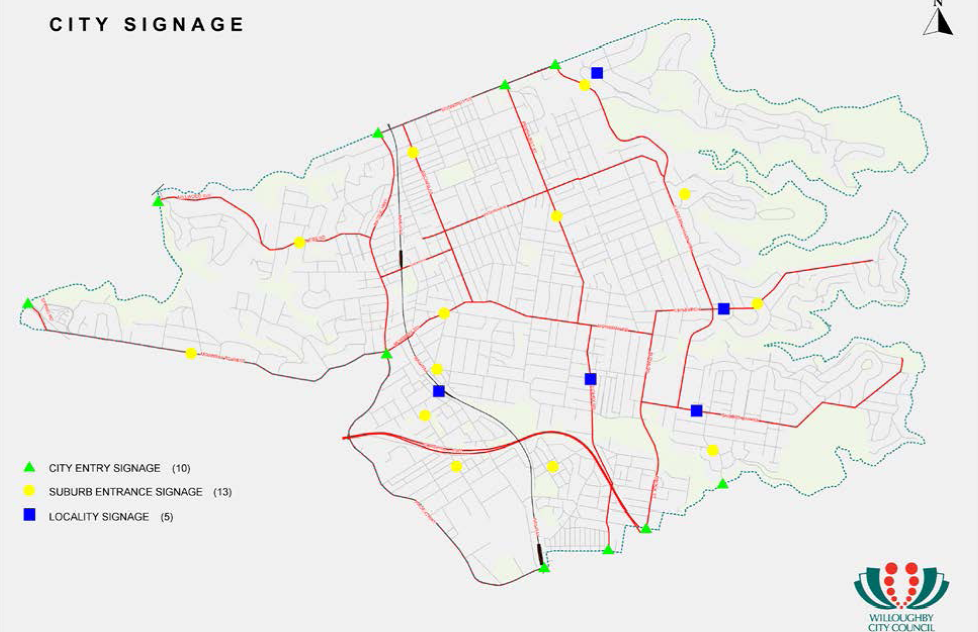
oie_14232219Z5u4uj88Council officers have identified that in order to address the need for a customised signage approach, three levels of city signage may need to be developed.

City Entry Signs: These signs will be located at key entrance points to the city, replacing existing city signage. City entry signs will predominantly target vehicle traffic, using the slim-line vertical Ad Altissimo sign design as previously reported to Council.

Suburb entrance signage: These signs will be located at key suburb entrance points, replacing existing signage. Suburb entry sign will also predominantly target vehicle traffic, using the Ad Altissimo sign design derivative as previously reported to Council.

Suburb or locality signs: These signs will be located at local /and strip shopping precincts. This signage will target pedestrian traffic, and is similar to the type of signs used in the City/ and Chatswood Mall. It will incorporate Willoughby City Council branding elements, and be uniquely designed for the space. The sign design will offer suburb individuality and connectivity and support the economic development of strip shopping centres. It will be designed following consultation with the local and retail community.

NOTE: We are attempting to obtain a better map of proposed signage.

Free Wi-fi in the Mall Update

This report is going to Council Committee on 18th November

Background
In the Council Meeting held on 3 December, 2012, Council resolved to go ahead with the proposal put forward by Star-tech to install a free Wi-Fi service in Chatswood Mall on a 6 month trial.

Discussion
Star-tech installed a free Wi-Fi service in the Chatswood Mall as per their proposal which went live on the 22nd April 2013. Star-tech’s initial model was to raise revenue to support the ongoing infrastructure costs through advertising in conjunction with a marketing company SkyHub.

The free Wi-Fi service has been very successful with an average monthly patronage of over 1,100 unique users and almost 14,000 sessions during this time. The service has been provided without any technical or performance issues and has offered the public fast, reliable and robust access to the internet.

The expected advertising revenue projected by the proponent has not come to fruition and as a result Star-tech have revised their free Wi-Fi service model going forward after the six month trial period.

The proposal going forward is for Council to pay an annual maintenance fee of $5000 ex GST for the ongoing use of the free public access Wi-Fi service. It is worth noting that Council has not expended any funds at this stage for the installation of this project, and the $5000 will cover the costs originally foreseen as revenue raised through advertising.

Similarly, it is also worth noting that a free Wi-Fi service is seen as a critical component of economic development of business districts and this minor investment has a good impact on users of the Chatswood Mall.

OFFICER’S RECOMMENDATION
That Council note the report and support the continuation of the free Wi-Fi service in the Chatswood mall

Urban Screen

UrbanScreenThe Urban Screen at The Concourse has been operated by Urban Screen Productions for over a year. The tender for the operation of the urban screen required that it must be in accordance with Willoughby City Council’s General Governing Principles and Operating Guidelines for the Screen. Under these Principles all content must adhere to this document and:
a) Be appropriate to a ‘G – rate’ audience
b) Be of a high quality
c) Reflect the unique marketing niche of The Concourse; and
d) Observe all relevant Acts and Statues and Willoughby City Council’s policies and procedures.

These Governing Principles and operating guidelines were previously adopted by Council on 12 December 2011.

It is now proposed to allow screening of M-rated content after 8:30PM.

New Strata by-laws

New by-laws allowing pets in units, curbing smoking on apartment balconies and preventing the installation of noisy timber and tiled floors are among the changes in the biggest overhaul of strata laws in more than 50 years. Currently nearly 30 per cent of people in NSW live in strata apartments. By 2033 it is expected that half the state’s population will live in apartments or townhouses.

One of the biggest changes proposed is to allow apartment to be sold to a developer with only 75% of owners being in favour of the proposal.

dog

The new by-laws will make it easier to keep animals in apartments.
The new model bylaws will, for the first time, cover smoke drift and allow pets by default, rather than banning them as is now the case. The issue of noisy timber and tiled floors will be addressed before the floors are laid, rather than after they become a problem, as happens now.


Along with an end to proxy harvesting – where one owner rules a whole building using votes mostly from non-residents – and encouragement for tenants’ participation in apartment block affairs.

And the “disgusting” business practice of phoenix companies – where developers deliberately go into insolvency to avoid the financial consequences of shoddy work and defective buildings, only to reappear with a new name but the same owners and directors – will soon be no more.

 Effectively curbed elsewhere in Australia, proxy farming in NSW often leads to individuals ruling their buildings as their personal fiefdom, their voting power bolstered by “blind” proxy votes from investor owners.
Noting that proxy farming created mistrust, resentment and ultimately disengagement from communities that are supposed to run their own affairs, Mr Roberts said the new laws will restrict proxy votes in schemes of more than 20 units to 5 per cent of the ownership. In buildings of 20 units or fewer, owners will only be allowed to carry one proxy vote.

Other possible changes include postal votes and secret ballots as part of the package, as well as online teleconferencing, electronic voting, flexibility in the timing of annual meetings and greater transparency.

Executive committee members will have to declare conflicts of interest and then remove themselves from voting on issues where any exist. Anyone who has a professional financial interest in the building – such as strata managers, building managers, caretakers and agents – will no longer be allowed to sit on executive committees.

The length of strata management contracts will be reduced, making it easier for dissatisfied owners to change managers, and there will be complete transparency about issues such as insurance commissions so that owners corporations know exactly what they are getting.

Some contentious issue shave been consigned to the ”too-hard” basket: extinguishment of strata title and other policies that intersect with other government departments – such as the thorny issue of short-term or holiday lets in residential buildings, and the perennial problem of rogue parking – have apparently been set aside for a second tranche of law changes mooted for later next year.

The new laws are slated to come into force by mid-next year.

Mowbray Rd Issues

The following comments have been placed by the Editor on behalf of a Lane Cove North resident. At the end of the comments see the response from Steven Head, Willoughby Council’s Director with responsibility for traffic matters.

oie_12741jZlMmB3U (1)

Location of Pedestrian Refuges & Intersections on Mowbray Road.

After consultation with the Lane Cove North community back in 2006 and notification that traffic management strategies in response to the Lane Cove Tunnel would be implemented in early 2010, it seems that the “Local Street Improvements” will now be installed in the next 6 months, some 4 years later.

There was never any official notification to the community as to why the strategies were never implemented back in 2010 and the only way I was made aware of the impending installation of Pedestrian Refuge Points was through a Lane Cove Council speaker at the recent Stringy Bark Creek Residents Association AGM. I was in agreeance that these strategies to manage traffic and pedestrian safety were necessary at the time and submitted my choices from those offered.

Since the initial consultation with the Lane Cove North community a large portion of the suburb known as the Mowbray Precinct (southern LCC side) has been rezoned to High Density with some 600 units either completed, under construction or approved with more to come. MowbrayPublic School which my children attend is now also to undergo a major upgrade commencing mid 2014 increasing from a current capacity of approx 370 students to accommodate 800-1000.

The Traffic Study carried out retrospectively by SMEC to assess the suitability of theroad network to cope with High Density living focused on the area of High Density development only and not the northern side of Mowbray Road which is in Willoughby Council and has not been zoned High Density. Mowbray Public School is also located on the northern side in Willoughby Council.

There is a need and an expectation of consultation with the Lane Cove North community regarding changes to Mowbray Road, most of whom reside in the Willoughby Council LGA. There are not many residents left in the Mowbray Precinct (Lane Cove Council) as they have either sold to developers and left the area or waiting to sell and move away. The many new residents that are about to move in don’t have a voice in what happens in what will be their community too.

All the intersections along Mowbray Road need to be considered individually and as a whole in light of the Up zoning of the Mowbray Precinct and the Upgrading of the school encompassing both sides of the street (Willoughby & Lane Cove Councils). There will be dramatic increases in vehicular traffic, pedestrian activity and demand for public transport. Each intersection needs to be designed and managed to work as smoothly and efficiently as possible for vehicles including buses, pedestrians and residents.

The location of Bus Zones at these intersections is of particular importance to my family as one is located outside our property. We experience difficulty accessing our property now as the bus blocks the driveway every time it stops. This often leaves us unable to exit or enterour property and will find that we are holding up traffic on Mowbray Road waiting to turn coming from either direction. With increased patronage of the bus services and the likelihood of extra services being added this will only further exacerbate the current problem.

SMEC’s Traffic Study has recommended turning bays be installed in the center of Mowbray Road into side streets. This would allow traffic to continue to flow along Mowbray Rd which would be beneficial and deter vehicles turning into back streets to avoid the traffic on Mowbray Rd. However the Bus Zone near Mooney St would need to be repositioned to allowthat traffic to continue along Mowbray Road and this is likely to be the situation at other intersections also.

Would this not then mean that the proposed Pedestrian Refuge Point west of Mooney St may not be optimally located to service the Bus Zone when it moves from its current position?

From my observations driving along Mowbray Rd the majority of Bus Zones on the southern Lane Cove Council side of Mowbray Rd are located where there is enough space between the driveway access to properties so as not to block access. However this is not the case on the northern Willoughby Council side of Mowbray Rd where Bus Zones often are located to block property access. It may be better to not have as many Bus Zones, have themnot located quite so close to intersections and position them where there is more space between driveway access to not obstruct properties.

The planners and architects working on the school upgrade are also looking at traffic management and pedestrian access in the vicinity with discussion of a Kiss and Drop outside the school along Mowbray Road and the installation of a round-about at Willandra St to allow traffic coming from the east to be able to drop children outside the school. Since the post Lane Cove Tunnel recommendations the SMEC Study proposes installationof traffic lights at Hatfield St and Mowbray Road to service the school and the Mowbray Precinct.

One intersection that appears to have been overlooked in the SMEC Study is Felton Ave as it does not service the Mowbray Precinct on Lane Cove Council side. It does however service numerous residents in Lane Cove North and the St Peter’s Green facility (Willoughby Council side). Currently there are traffic hold ups on Mowbray Road as cars wait to turn off into Felton Ave and with parked cars, a pedestrian refuge and two Bus Zones is a very busy intersection that also needs to be managed more effectively.

The intersection of Mowbray Road and Centennial Ave has needed a right hand turn arrow for motorists travelling east on Mowbray Rd turning into Centennial for many years. I generally take an alternate back street route so as to avoid trying to make the turn at the traffic lights as you either make the turn on the orange light or sit through a number of phases of the traffic lights. I’m sure many other motorists do the same as to turn at the lights is difficult if not dangerous.

My primary concern is the apparent piecemeal approach to the whole management of the traffic and pedestrian issues along Mowbray Road.. The problems that arise due to the number of parties involved, Lane Cove Council, Willoughby Council and now the Department of Education. The lack of community consultation for the residents of Lane Cove North in particular those on the northern Willoughby Council side of the street and adjoining streets. Having to be constantly proactive in seeking out information regarding my community. This should be readily and easily available to all, both Willoughby Council and Lane Cove Council residents.

I would like to know how access to my property moving forward is going to be improved not hindered? And with so many parties involved, where does the Lane Cove North community find answers to their questions and raise their concerns about the drastic changes going on in our neighbourhood which we have to endure on a daily basis?

These include incessant construction noise, noisy B-double trucks that queue on the street and arrive as early as 5am often parked in Bus Zones or across driveways, cement mixer trucks which also queue out on the street and are very noisy,regular traffic hold ups on Mowbray Road due to trucks ordigging up the road which often make it difficult to access my property, workers vehicles parked on Mowbray Rd and adjoining side streets making access and visibility difficult, vehicles parked in playgrounds and in nature reserves, vehicles making turns illegally at “No Right Hand Turn” signs, whole day power interruptions from 8am-4:30pm, Sydney Water digging up my driveway to install a manhole cover, unkempt worksites, rubbish being dumped, overgrown nature strips and damaged footpaths. These issues are only a part of the construction phase which is likely to go on for years. What about the impacts on the traffic and the community when the population starts to explode?

We need Traffic & Pedestrian measures in response to the huge changes thatwill be a direct result of the Up zoning of the Mowbray Precinct and the Upsizing of Mowbray Public School. We need a forum for the Lane Cove North community that transcends Council boundaries and Government Departments to be able to access information about all the development in our neighbourhood and to have some input into proposed changes. It seems a bit late now to be implementing changes based on studies carried out in relation to the Lane Cove Tunnel some 7 years ago! Lane Cove North Resident

Response from Willoughby Council

Thank you for your email and attachment outlining a need for consultation and input from the community north of the Mowbray Rd regarding proposed traffic management changes along Mowbray rd. Officers from Lane Cove have recently briefed officers from Willoughby Council and we are currently preparing a report to Council outlining how we will be engaging with the community regarding these proposed changes.

Your suggestion of a public meeting or forum or open day to present and discuss the findings from the study and the proposals has merit and we will consider that in the report to Council. Addressing the matter with as little reference to Local Government borders or departmental demarcation

to get the best result for all the community also has merit and hopefully is the approach we are already pursuing.

Steven Head, Director Infrastructure Services, Willoughby City Council
Asset Renewal

Willoughby Council owns a wide range of ageing assets. This includes roads, footpaths, kerb & gutter, stormwater pipes, bridges, buildings, sportsgrounds, parks and playgrounds. The ability to raise funds to maintain these assets to an appropriate level is arguably one of the biggest challenges facing Council in the coming decades. For decades under the nSW Government’s ‘rate pegging’ regime, Councils across NSW (including Willoughby) have been under resourcing asset renewal.

Council has completed an assets survey, so now has a good idea of its assets and the condition they are in.

The next part of the process was to determine the ‘renewal threshold’ for each category of asset. RenewaL thresholds range from 0 (for a brand new asset) to 6 for an asset at the end of its life. Depending on the ‘renewal threshold’ adopted between 0 & 6, the cost of maintaining or replacing an asset will be lower (if say a category 2 threshold is adopted) than higher (if say a category 4 threshold is adopted). Council Officers have looked at the assets and formed an opinion regarding the renewal threshold that should be adopted. In addition, a Citizen’s Panel was used to obtain the communities’ view as to what renewal threshold should be adopted. Largely, the Citizen’s Panel outcomes were similar to Council Officer’s recommendations (it was refreshing to see in some instances, based on technical issues,that the Council Officers were recommending a lower level of threshold that the community was prepared to accept).

It was recommended that Council adopt the asset renewal thresholds for each category of asset. Council staff are to report in December with revised scenarios for asset expenditure, recommendations about funding and a works program to address any gaps identified.


Off-street parking

Parking station

Councillor W Norton has indicated her intention to move the Notice of Motion below. It is logical to consider both on-street and off-street parking at the same time..


Motion

THAT Council undertake a review of the parking provisions within the WDCP. In the first instance, the issue should be discussed in a workshop or at a committee meeting where current information regarding car ownership can be provided and decisions made about further information needed prior to council either affirming or modifying the current policy.

Background
Council Officers have recently provided a report on street parking provisions within the city. This will be considered early in 2014. However, street parking is significantly influenced by the amount of off street parking provided in new developments. Current policy attempts to dissuade residents from car ownership by limiting parking in new residential developments (“demand parking”). Resident cars in excess of the parking spaces within these developments are parked on our streets. There is limited parking available on the City’s streets.

It is suggested by many that the current policy is exacerbating our street parking problems rather than ameliorating them.

The current policy has been in place for many years and it is time for it to be re-examined.

General Manager’s Comments

This matter was raised at the Councillors Strategic Planning Workshop. The Councillors’ priorities included to ensure there is adequate provision for private car parking in new developments including a review of car parking ratios.

The Parking Strategy has been deferred till early 2014 and whilst that Strategy primarily deals with on street public car parking, rather than private on-site parking, a workshop to discuss the matter raised in the Notice of Motion would provide direction for staff as to the issues that can be covered in the review.

It was envisaged that this matter would be reported to Council in mid-2014, depending on other project commitments.

Meriton Appeal

Meriton has appealed to the Land and Environment Court the PAC decision not to grant them increased development on the Albert Avenue car park site near the railway line. Meriton want

  • 47 storeys in residential tower instead of 29 (18 increase)
  • 355 apartments instead of 233 (122 increase)
  • 37 storeys in serviced apartment block rather than 29 (8 increase)
  • serviced apartments from 301 to 359 (57 increase)
  • parking spaces from 508 to 660 (52 increase)

The initial phases of the appeal is a ‘conciliation conference’ between Meriton and the PAC. The conciliation conference is set down for 9:30 am onsite on 22 November 2013. In the event that no agreement can be reached the searing is listed to start on-site at 9:30am on 11th-13th December 2013.

The Minister for Planning’s position is that those that made a submission should be given the right to speak at the Conciliation Conference.

The PAC website will be kept updated with information about the appeal

Chatswood Post Office

Council has received a proposal to rezone the Chatswood Post Office site.

This is the second planning proposal for 45 Victor Street. The previous proposal 2012/2 was reported to the Council meeting of 17 June 2013. At the request of Australia Post, the report was withdrawn from the meeting.

The purpose of the Planning Proposal is to amend Willoughby Local Environmental Plan 2012 (WLEP 2012) to allow shop top housing to occur on the site by adding “shop top housing” as an additional permitted use in Schedule 1 of WLEP 2012 while retaining the Commercial Core B3 zoning for the site.

The development standards for the site requested in the Planning Proposal are:

  • Increase the maximum height limit from 12 metres (about RL 106.5) to 141 metres (RL 235). The report advises this provides for a building that is approximately 42  storeys in height plus a plant room. (This height is similar to the Chatswood Interchange eastern tower or approximately 1 ½ times the height of the Sebel).
  • Remove the floor space ratio control for the site (currently 2.5:1) to allow the building to be defined by a building envelope.
  • Require a minimum of 2,066m2 of gross floor space in non-residential commercial use that would include a Post Office shop on the ground floor.

The indicative concept plans and report accompanying the Planning Proposal indicate that this would deliver approximately 300 residential units on the site in addition to the 2,066m2 of retail and office floor space.

The Officer’s Recommendation is that the Planning Proposal not be supported and the proponent be advised accordingly.

Voluntary Planning Agreement (VPA)

The VPA report goes to Council on 11th November 2011. The report outlines that submissions were received from the West Ward Progress Association Dr. Ong and Jim McCredie however the Officer recommended the adoption of the exhibited report without change. Access to both Volumes of the Report can be here.: 

Full details from the report follow below:

 
Submissions relating to the exhibition are contained at Attachment 3 a summary of submissions follows:

Identified submissions were received from the Chatswood West Ward Progress Association, Dr Leonard Ong and Jim McCredie. Three comments were received on the Have Your Say section of Council’s website without identifying names or addresses.

The submissions expressed (to varying degrees) concern that development can occur (and could be seen to be being encouraged) that is not consistent with the existing planning controls. Such agreements increase the risk of conflicts of interest for Council officers and councillors and give rise to inconsistent decisions which vary the planning rules.

The Chatswood West Ward Progress Association submission states:

That this Association opposes the use of VPAs where LEP conditions are breached and that Council should uphold the conditions within their adopted LEPs.
It was also the meetings view that the concept of VPAs be reconsidered in the context of any new Planning Legislation.”

The submission from Dr Leonard Ong includes:
1. The difficulty of avoiding a special advantage to one developer over
another.
2. The risks of variability.
3. The importance of objectivity and fairness.
4. Council should be responsible for community facilities.

The submission from Jim McCredie includes:
1. A VPA that breaches the LEP amounts to a conspiracy to violate the community LEP.
2. The acceptance of VPAs in support of spot rezoning violates the central purpose of zoning within an LEP.
3. The return from rezonings for developers is in excess of the cost of a VPA.

Comment on Submissions
The opposition to voluntary planning agreements and hence, the Draft Voluntary Planning Agreement Policy, is noted.

The regime for Voluntary Planning Agreements was introduced by the Environmental Planning and Assessment Amended (Development Contributions) Act 2005 and subsequent Regulations on 8 July 2005. The State Government has created this regime for all councils.
The intent of having a Council policy is to make explicit the terms on which a VPA might be entered into so that the community and applicants know Council’s approach and the public process that would be followed. Council does not have to enter a VPA. Each VPA proposal needs a resolution of Council after public debate in Council.
The draft VPA Policy does not advocate the trading of LEP variations for public benefits. As stated in the Council Report dated 16 September 2013:

“It is proposed that the Council’s use of voluntary planning agreements will be governed by the following principles:
a) Planning decisions will not be bought or sold through planning agreements.
d) Development that is unacceptable on planning grounds will not be permitted because of planning benefits offered by developers that do not make the development acceptable in planning terms.”

The planning legislation and Council’s WLEP 2012 already allows for a degree of flexibility in applying development standards to particular development. The variation of development standards (Clause 4.6 of the WLEP 2012) is enabled so long as the variation is justified by the applicant on the basis of adequate environmental planning grounds and demonstrating that compliance is ‘unnecessary and unreasonable’ in the circumstances. A VPA is not required for variations under Clause 4.6 of the WLEP 2012. The draft Policy states that significant variations should be sought by amending the WLEP 2012 not through the VPA process.

At present Council has entered into 2 VPAs:
1) For the site at Gore Hill Technology Park, where government owned land, the former ABC site, was rezoned from Special Uses. The VPA with the site developer followed an existing Memorandum of Understanding between the ABC and Council to provide community benefits (including heritage installation, site access and community facilities) as a result of the sale of government land.
2) Between Council and a Mandarin Centre restaurant operator, to provide a monetary contribution towards Council for additional car parking spaces to be built in the Albert Avenue Car park which could not be provided within the existing complex.

The new Planning Bill 2013, introduced into Parliament in late October 2013, provides for Planning Agreements in Division 7.5. Under the Bill, a Planning Agreement requires the developer to provide land / money towards ‘the provision of infrastructure that is identified in a local infrastructure plan’ (currently called a S.94 or S.94A Contributions Plan). This means that a Planning Agreement must relate to infrastructure identified by the Council in a local infrastructure plan prepared and publicly exhibited in accordance with the Act and any future regulations.

It is proposed that the VPA Policy be reviewed by Council after the new Planning Act and Regulations commence and State Government guidelines for VPAs are published, to consider the new provisions relating to Planning Agreements.

Conclusion
The Voluntary Planning Agreement Policy has been publicly exhibited. As stated in the Council Report dated 15 September 2013, the Policy seeks to reflect the Council’s position on the process for negotiation and potential basis for entering into a voluntary planning agreement which go beyond the statutory processes of the Environmental Planning and Assessment Act and Regulations.

Three identified submissions and three unidentified comments were received as outlined in the report and at Attachment 3.

It is recommended that Council adopt the Voluntary Planning Agreement Policy